
Key Takeaways:
- Optimizing your Google Business Profile is the single highest-leverage action a contractor can take to generate local leads from Google Maps.
- Consistent NAP (Name, Address, Phone) data across all online directories directly impacts how Google ranks your business locally.
- Reviews, photos, and regular posting activity are not optional extras — they are active ranking signals Google measures continuously.
If you run a contracting business in the United States — roofing, plumbing, HVAC, electrical, or any skilled trade — showing up in the Google Maps 3-Pack is one of the most valuable things you can do for your revenue. That top section of local results, the map with three business listings directly underneath, captures an enormous share of clicks from people who are ready to hire right now.
This guide breaks down exactly how to get there.
Why Google Maps Rankings Matter More Than You Think
When someone searches “roofer near me” or “AC repair Fort Myers,” Google doesn’t show them a list of websites first. It shows them a map. Three businesses. A phone number. A review score. A button to get directions.
Most people never scroll past those three listings.
That map pack is driven by Google’s local ranking algorithm, which weighs three core factors: relevance, distance, and prominence. You can’t control distance much — Google is going to rank businesses geographically close to the searcher. But relevance and prominence? Those are entirely within your control, and that’s exactly what this guide addresses.
Step 1: Claim and Fully Optimize Your Google Business Profile
Your Google Business Profile (GBP) is the foundation of your local visibility. If you haven’t claimed it yet, go to Google Business Profile Manager and do that first. If you have claimed it, the next question is: how complete and accurate is it?
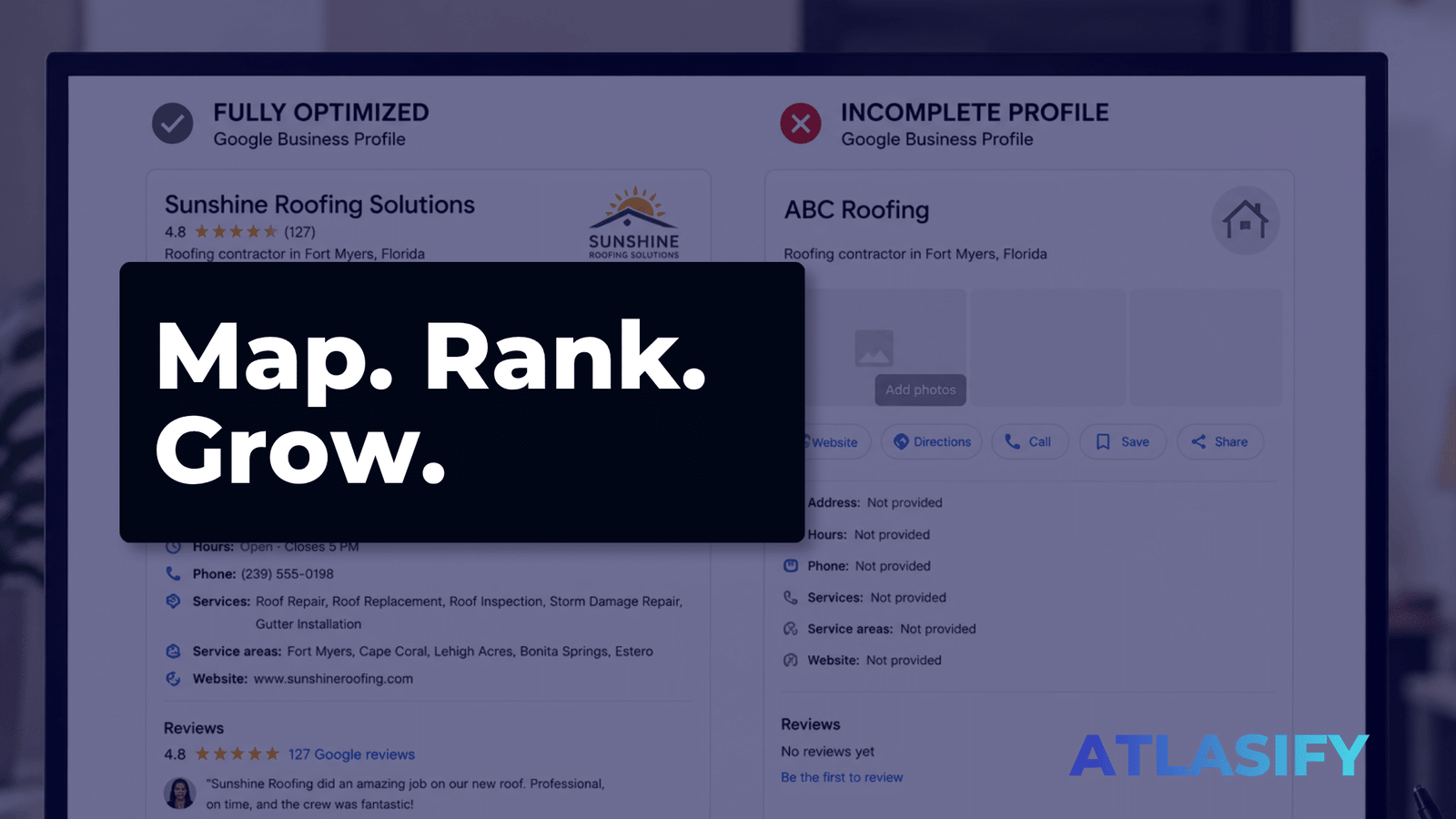
Here’s what a fully optimized GBP looks like for a contractor:
- Business name: Use your real business name. Don’t stuff keywords into it — Google has cracked down hard on this and it can get you suspended.
- Primary category: Choose the most specific, accurate category. “Roofing Contractor” beats “Contractor” every time. Add secondary categories where they honestly apply.
- Service area: List every city and zip code you actually serve. Don’t pad this with markets you’ll never work in.
- Business description: Write 750 characters that describe what you do, who you serve, and what makes you different. Include your main service keywords naturally.
- Phone number: Use a local number with the correct area code. Toll-free numbers hurt local trust signals.
- Hours: Keep them accurate and updated. If you offer emergency services, say so.
- Website link: Point it to your homepage or a relevant landing page.
After you fill out every field, don’t stop there. Your GBP is not a set-it-and-forget-it tool. Google rewards profiles that show signs of life.
Step 2: Build Consistent NAP Citations Across the Web
NAP stands for Name, Address, Phone. Google crawls hundreds of directories — Yelp, Angi, HomeAdvisor, BBB, Houzz, Thumbtack, and dozens of others — looking for consistent business information. When your NAP matches perfectly across all these sources, Google’s confidence in your business data goes up. When it doesn’t match, it creates confusion and suppresses your ranking.
This is not glamorous work, but it matters enormously. A contractor who moved offices three years ago and never updated their old directory listings is leaking ranking potential every single day.
Priority citation sources for contractors:
- Google Business Profile
- Yelp for Business
- Angi (formerly Angie’s List)
- Better Business Bureau
- Houzz
- Thumbtack
- Facebook Business Page
- Apple Maps
- Bing Places
- Your local Chamber of Commerce
Use a tool like BrightLocal or Whitespark to audit where you’re listed and where your data has errors. Fix inconsistencies methodically. This is a one-time cleanup that pays dividends for years.
Step 3: Generate and Manage Google Reviews Aggressively
Reviews are one of the most powerful local ranking signals Google uses. The quantity, recency, and quality of your reviews all feed directly into how often your business appears in map results and how high it ranks.
For contractors, this is actually an advantage. You have ongoing customer contact. Every completed job is a review opportunity. Most contractors just don’t ask.
A simple review generation system that works:
- Complete the job and confirm the customer is happy before you leave.
- Send a follow-up text or email within 24 hours with a direct link to your Google review page.
- Personalize the ask. “Hi Mark, it was great working on your roof — if you have two minutes, a Google review would really help our team.”
- Make the link frictionless. Use a shortened URL that takes them directly to the review form.
- Respond to every review, positive or negative. This signals activity and professionalism to both Google and potential customers.
A target benchmark: aim to be the most-reviewed contractor in your service area within your primary category. If your competitors have 40 reviews and you have 200 with a 4.8 average, you have an enormous trust and ranking advantage.
Step 4: Optimize Your Website for Local SEO Signals
Your GBP doesn’t operate in isolation. Google cross-references your website to validate your business information and measure your authority. A weak website undermines even a perfect GBP.
Critical on-site elements for contractor local SEO:
- Title tags and H1s should include your primary service and city. “Roofing Contractor in Fort Myers, FL” is direct, relevant, and effective.
- Embed a Google Map of your business location on your contact page.
- Create individual service pages for each major service you offer. Don’t bundle everything onto one page. One page for roof replacement, one for roof repair, one for commercial roofing — each targeting its own local keyword set.
- Create location pages if you serve multiple cities. A dedicated page for each market you serve helps you rank in searches from those areas.
- Schema markup: Add LocalBusiness structured data to your site so Google can read your NAP, hours, and service details programmatically.
If you’re serious about dominating local search across Florida, pairing your GBP work with a structured SEO geo-targeting strategy makes a measurable difference, especially when you’re competing across multiple service areas.
Step 5: Post Content to Your Google Business Profile Regularly
Most contractors don’t know that Google lets you publish posts directly to your GBP — similar to a social media post, but built directly into your map listing. Google uses posting activity as a freshness signal.
Post at minimum once a week. What to post:
- Completed project photos with a short description
- Seasonal promotions or special offers
- Announcements about certifications, licenses, or awards
- Links to recent blog content or case studies
Each post should include a call-to-action button pointing back to your website or phone number. This creates engagement signals that tell Google your business is active and worth surfacing.
Step 6: Upload High-Quality Photos Consistently
Photos matter more than most contractors realize. Google’s own data shows that businesses with photos receive significantly more direction requests and website clicks than businesses without them.
Upload real photos — not stock images. Real job-site photos, before-and-after results, your trucks, your crew, and your completed work. Geo-tag your photos if possible, as this reinforces your service area geography.
Aim for at least 20-30 photos on your profile. Then keep adding. Profiles with hundreds of high-quality, recent photos dramatically outperform those that were set up once and never updated.
Step 7: Build Local Backlinks to Strengthen Your Authority
Backlinks are still one of Google’s top-three ranking factors, and they influence local results too. For contractors, the goal isn’t to get thousands of links — it’s to get the right links from locally relevant, trustworthy sources.
High-value local backlink sources:
- Your local Chamber of Commerce website
- Local news sites (pitch a story about a community project you completed)
- Supplier and manufacturer websites (many have contractor directories)
- Local home builder associations
- Nonprofit organizations you’ve donated work or services to
- Sponsorships of local sports teams or events
One solid link from a respected local news site is worth more than 50 links from random directories. Focus on quality and local relevance.
Step 8: Track Your Rankings and Adjust
You can’t manage what you don’t measure. Use tools like BrightLocal, GeoGrid (available through platforms like Local Falcon), or Whitespark to track your Google Maps rankings across your service area — not just from your office address, but from different geographical grid points within your market.
Check your GBP Insights regularly. How many calls came from your listing? How many direction requests? How many website clicks? These metrics tell you whether your optimization efforts are moving the needle.
If you’re competing in a saturated market — like HVAC in a major metro area — combining organic local SEO with targeted paid media campaigns gives you coverage while your organic rankings build. Paid and organic working together captures more of the available search real estate simultaneously.
How Atlasify Helps Florida Contractors Dominate Google Maps
Based in Fort Myers, Atlasify works exclusively with trade contractors and local service businesses across Florida. The entire operation is built around one outcome: getting you direct, tracked leads that convert into booked jobs.
Whether you’re a roofer in Naples, a plumber in Tampa, or an HVAC technician in Jacksonville, the local ranking playbook is the same — but execution at scale requires systems, expertise, and consistent effort. Atlasify handles the full stack: GBP optimization, citation building, review strategy, local content, and link acquisition.
The contractors who win in Google Maps aren’t lucky. They’re systematic. They treat their local presence like the marketing asset it is, and they have a team behind them that understands exactly how the algorithm works.
Google Maps Ranking Factors at a Glance
| Ranking Factor | What It Means | Priority Level |
|---|---|---|
| Google Business Profile Completeness | Every field filled out accurately | Critical |
| Review Quantity & Recency | More recent 5-star reviews = higher trust | Critical |
| NAP Consistency | Same name, address, phone across all directories | High |
| Website Local SEO Signals | Location-specific pages, schema markup, local content | High |
| GBP Post Frequency | Regular posts signal an active, relevant business | Medium |
| Photo Volume & Quality | Real, geotagged, job-site photos updated consistently | Medium |
| Local Backlinks | Links from local news, associations, and directories | High |
| Behavioral Signals | Clicks, calls, direction requests from your listing | Medium |
Conclusion
Ranking on Google Maps is not a mystery. It’s a discipline. The contractors who consistently appear in the 3-Pack in their markets are doing the same core things: their profiles are complete, their reviews are strong, their citations are clean, their websites reinforce their local relevance, and they keep adding fresh signals over time.
None of these steps require a massive budget. They require consistency, attention to detail, and a clear understanding of what Google is actually measuring. Start with your Google Business Profile, fix your citations, build your review volume, and then layer in the more advanced strategies as your foundation solidifies.
If you want to shortcut the learning curve and get a team working on this for you, reach out to Atlasify and get a clear picture of where your business stands and what it would take to move you to the top of local results in your market.
Frequently Asked Questions
How long does it take to rank on Google Maps as a contractor?
Most contractors see meaningful movement in their local rankings within 60 to 90 days of consistent optimization. Competitive markets may take longer, but the foundational steps — completing your GBP, cleaning up citations, and generating reviews — often produce visible improvements within the first month.
Does having more Google reviews help you rank higher on Maps?
Yes. Review quantity, review recency, and your average rating are all signals Google uses in its local ranking algorithm. A contractor with 150 recent reviews and a 4.8 rating will typically outrank a competitor with 20 old reviews, all other factors being roughly equal.
What is the Google Maps 3-Pack and why does it matter for contractors?
The 3-Pack is the block of three local business listings Google displays at the top of search results for local queries, usually above organic website results. It shows business name, rating, phone number, and a map pin. This placement gets a disproportionate share of clicks from users who are actively ready to hire, making it one of the highest-value positions in local search.
Can I rank on Google Maps if I don’t have a physical office?
Yes. Contractors who serve customers at their location (rather than having a storefront) can set up a service-area business on Google. You hide your physical address and define the cities and zip codes you serve. This is completely legitimate and very common for contractors operating from a home address.
What’s the difference between Google Maps SEO and regular website SEO?
Regular SEO targets rankings in the organic blue-link results on Google. Google Maps SEO specifically targets the local map pack results, which are driven by your Google Business Profile, citations, reviews, and proximity signals — not just your website’s content. Both matter for contractors, but Google Maps SEO tends to drive faster and more direct lead generation.